
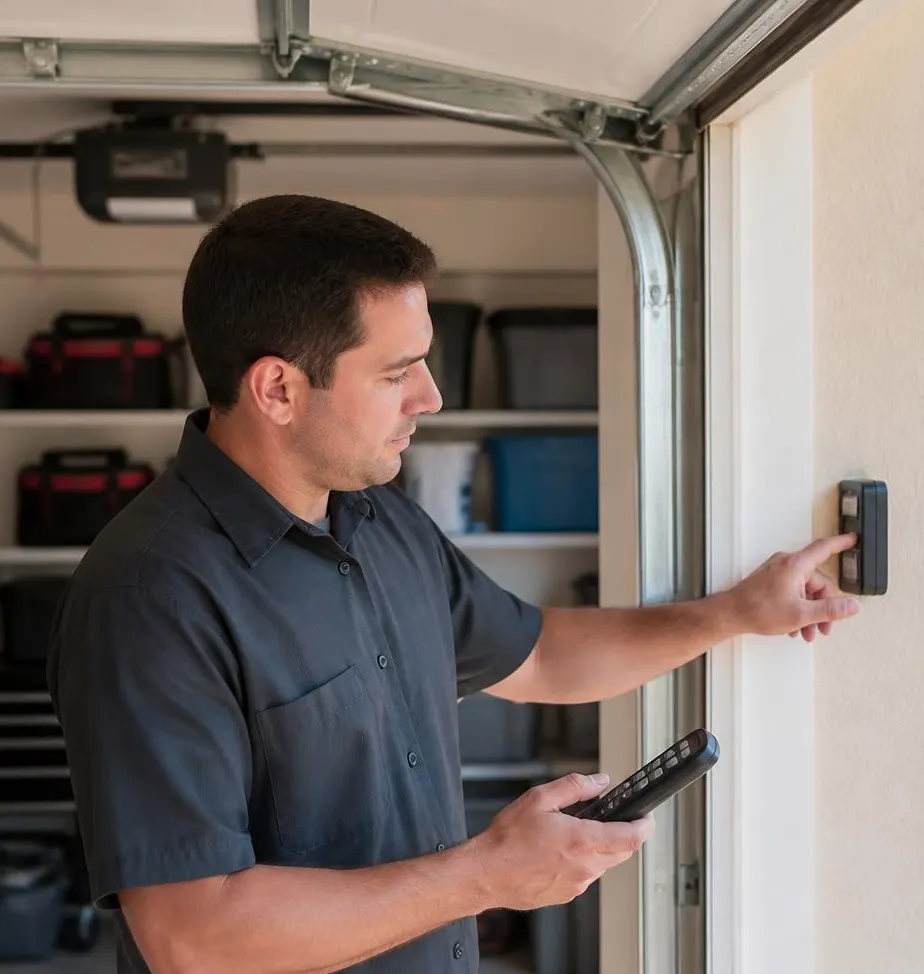
The first thing most homeowners do when the garage door starts grinding, squealing, or banging is grab a can of WD-40 and spray every moving part they can reach. It feels productive, it's cheap, and it's done in five minutes. The problem is that WD-40 is a solvent and light penetrating oil, not a lubricant built for the weight and friction of garage door hardware. It washes out old grease, attracts dust and pine pollen, and within a few weeks the noise comes back louder than before. Near the coast, where salt air and humidity are already working against your metal hardware, the wrong lubricant can speed up corrosion instead of preventing it.
Here's how to actually quiet a noisy opener, step by step, starting with the cheap fixes and ending with the point where it makes sense to call in a technician.
Tools You'll Need
- Socket wrench set and adjustable wrench
- White lithium grease (garage-door-rated, not WD-40)
- Silicone-based spray lubricant
- Sturdy ladder
- Work gloves and safety glasses
- Flashlight
- Rubber isolator pads (optional, for ceiling-mounted motors)
Step 1: Figure Out Where the Noise Is Coming From
Before touching anything, run the door up and down a couple of times and listen. A rattling, metallic noise usually points to loose hardware. A high-pitched squeal often means dry rollers or hinges. A rhythmic clanking as the door moves is frequently a worn or loose chain. A grinding sound from the motor unit itself is a different animal entirely and deserves its own section below. Knowing which noise you have saves you from lubricating a problem that's actually a loose bolt, or tightening hardware when the real issue is a dry roller.
Step 2: Tighten Every Bolt and Bracket (DIY)
Garage doors vibrate every time they operate, and over months that vibration works bolts loose, especially on roller brackets, hinges, and the track mounting plates. Walk the full length of the track with your socket wrench and snug up anything that moves. Don't overtighten; you're removing play, not trying to crush the bracket.
Step 3: Lubricate the Right Parts with the Right Product (DIY)
This is where most people go wrong, so slow down here:
- Rollers and hinges: white lithium grease, applied sparingly
- Springs: white lithium grease, light coat
- Tracks: a dry silicone spray, never grease — grease on the track attracts grit and pollen and actually makes the rollers slip
- Chain drive: a small amount of white lithium grease along the chain, wiped so it doesn't drip
Skip WD-40 entirely for this job. It has its place for freeing a rusted bolt, but it's too thin to stay put on parts under constant load, and it will leave you re-lubricating every few weeks.
Step 4: Inspect and Replace Worn Rollers (DIY if you're comfortable)
Nylon rollers are quieter than the old steel ones and are a common cause of squeaking once they start to crack or flatten. If you see visible wear, cracking, or flat spots on the rollers, they're inexpensive to replace and swapping a few at a time (never remove more than two adjacent rollers at once) is a reasonable weekend project. If the rollers look fine but the noise persists, move on rather than forcing a fix that isn't needed.
Step 5: Check Chain or Belt Tension (DIY with caution)
Most opener manuals show a tensioning bolt or nut where the rail meets the motor housing. A chain that's too loose will slap against the rail with every cycle; too tight and it strains the motor. Adjust in small increments and test after each change. If you're not sure your model's tension is correct, this is a fine moment to stop and let a technician handle it rather than guessing.
Step 6: Isolate the Motor from the Ceiling Joists (DIY)
A surprising amount of opener noise travels through the ceiling joists into the living space above the garage. Rubber isolator pads installed between the motor bracket and the joist absorb that vibration. This is a simple, cheap upgrade that makes a real difference if your garage shares a wall or ceiling with a bedroom or living area.
Step 7: Consider a Belt-Drive Swap (Professional Job)
If you've done all of the above and the opener is still noisy simply because it's a chain-drive unit on an aging motor, the real fix is upgrading to a belt-drive opener. Belt drives use a reinforced rubber belt instead of a metal chain, which eliminates most of the metal-on-metal clatter. This isn't a simple parts swap — it involves removing the old opener, mounting a new rail and motor assembly, and recalibrating the safety sensors and travel limits, so this is a job for a technician rather than a DIY afternoon.
When It's Time to Call a Technician, Not a Toolbox
Some noises aren't about lubrication at all. A loud bang or pop, especially paired with the door feeling heavier or refusing to open smoothly, usually means a spring issue, and garage door springs are under enough tension to cause serious injury if handled without the right equipment. Grinding or burning smells from the motor unit point to a failing gear set or motor, not something you want to open up yourself. And if your opener is old enough that parts are hard to find, a full opener replacement is often more cost-effective than chasing repairs.
This is also the point where our local conditions matter. Humidity, salt air, and heavy rain along the Crystal Coast speed up rust on springs and hardware, and pine pollen in spring mixes with grease to gum up tracks faster than it would further inland. If your opener noise keeps returning no matter how well you lubricate it, corrosion or wear inside the hardware itself may be the real culprit.
When to Call Atlantic Beach Garage Door Pro
If you've worked through these steps and the noise hasn't improved, or if you suspect a spring problem, a failing motor, or you're ready for a belt-drive opener installation, that's our cue. We'll inspect the full system, including the springs, track alignment, and opener gears, and handle garage door opener repair and installation safely, with the right tools and parts for coastal conditions. We also offer preventive maintenance visits so small issues like loose hardware or dry rollers get caught before they turn into a 2 a.m. grinding noise.
If your garage door opener in Atlantic Beach, Morehead City, or anywhere along the Crystal Coast is driving you crazy, give Atlantic Beach Garage Door Pro a call. We'll get it running quiet again, and keep it that way.